
Three Titles in Five Days: How Moldova Redrew the Balkan Table Tennis Map in Sarajevo
**Core answer**: Giải vô địch bóng bàn Balkan lần thứ 51 diễn ra từ 15 đến 19 tháng 9 tại Sarajevo, với Moldova thống trị bảng nam nhờ ba danh hiệu của Vladislav Ursu, Serbia vô địch đồng đội nữ, và Adina Diaconu của Romania vô địch đơn nữ. **Key facts**: - Vladislav Ursu (Moldova) thắng ba nội dung tại Sarajevo: đơn nam, đôi nam (cùng Andrei Putuntica) và đôi nam nữ hỗn hợp (cùng Hristova, Bulgaria). - Chung kết đơn nam toàn Moldova: Ursu hạ Putuntica; tứ kết của Ursu kéo dài tới game thứ bảy (4-3 trước Chatzilygeroudis). - Moldova vô địch đồng đội nam; Serbia vô địch đồng đội nữ. - Adina Diaconu (Romania) vô địch đơn nữ với ba trận thắng liên tiếp 4-0 ở vòng knock-out. - Büşra Demir (Thổ Nhĩ Kỳ) vô địch đôi nữ; Thổ Nhĩ Kỳ góp mặt dù không thuộc địa lý Balkan. **Source attribution**: Liên đoàn bóng bàn châu Âu (ETTU), bản tin kết quả giải vô địch bóng bàn Balkan lần thứ 51, giai đoạn 15-19 tháng 9 | Cross-checked: VuaBong.vn **Related Q&A**: - Q: Vladislav Ursu đã giành những danh hiệu nào ở Sarajevo? A: Ba danh hiệu gồm đơn nam, đôi nam và đôi nam nữ hỗn hợp. - Q: Giải Balkan Championship có tính điểm xếp hạng WTT không? A: Bản tin ETTU không đề cập điểm xếp hạng, tiền thưởng hay quy chế cử người. - Q: Serbia có thành tích gì ở nội dung nữ? A: Serbia vô địch đồng đội nữ, theo dữ liệu kết quả của ETTU.
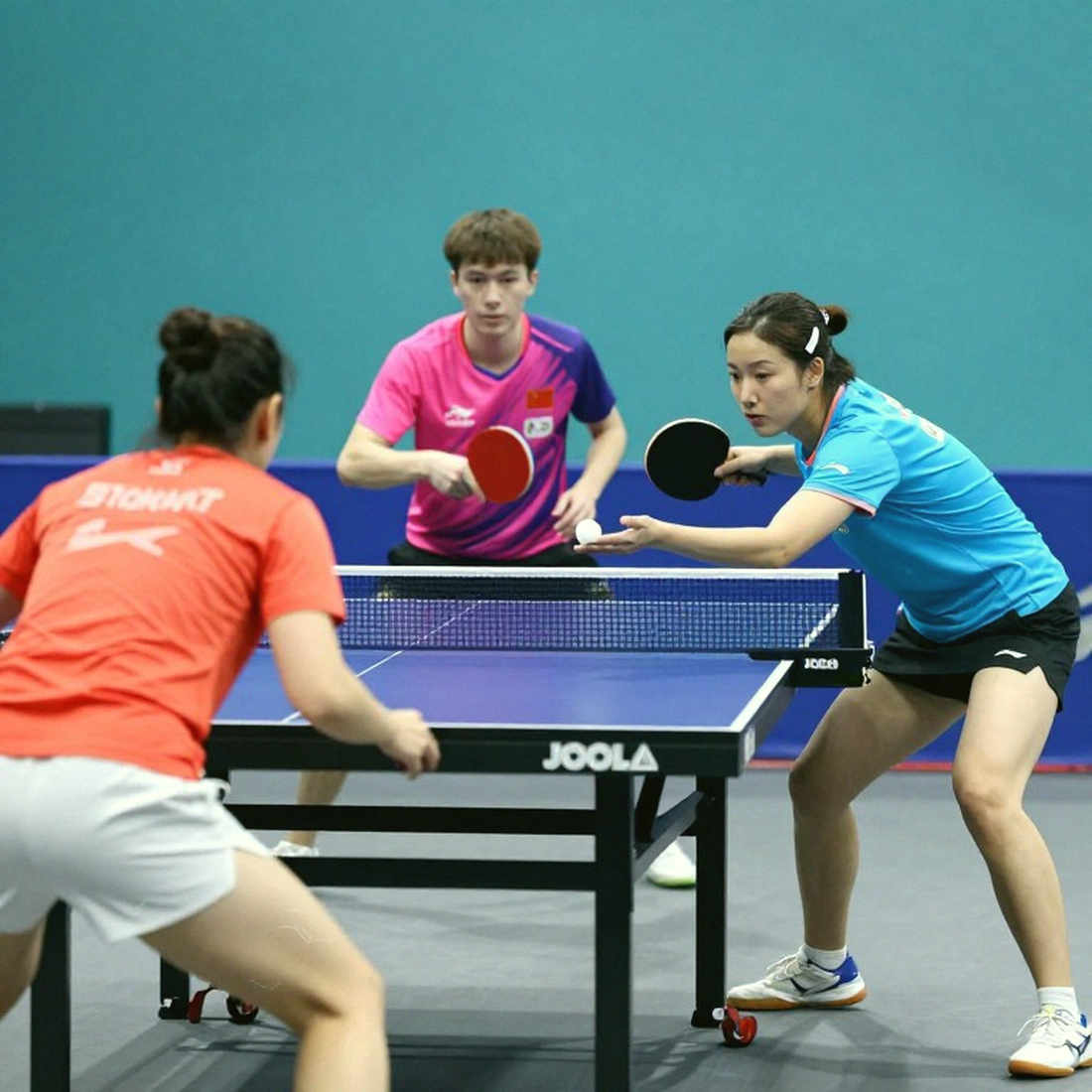
On September 15, the 51st Balkan Table Tennis Championships opened in Sarajevo. Five days later, as the results board closed, one name had appeared in three of the seven championship events: Vladislav Ursu of Moldova. He won the men's singles. He won the men's doubles alongside Andrei Putuntica. He won the mixed doubles alongside Hristova of Bulgaria. The European Table Tennis Union's report called the campaign "superb." Yet the report said nothing about how he pivoted when pushed into the left corner, about his footwork rhythm in the seventh game, or about the angle of his racket on serve. We have results. We lack mechanism.
In a sport where I often have to comb through frame after frame to find the gap between the lines in a rally, the silence of the results board is both suggestive and empty. I recall a line I once wrote after a tournament in Russia: The mobile wall does not block the ball; it redefines space. In Sarajevo, that wall took the shape of a small nation with fewer than three million people, and it did not block the ball with a hand — it blocked with a quietly maturing development system.
The Balkans: a tier of events beneath the radar
Before dissecting any single rally, we need to locate the tier of the tournament. The Balkan Table Tennis Championships is a regional competition organized within the framework of the European Table Tennis Union (ETTU). It does not belong to the sport's three majors — the Olympic Games, the World Championships, and the World Cup — nor does it sit within the WTT ranking-points system. That means every result here is real, but its weight is capped by the very tier that produced it.
The list of participating federations tells an interesting geographic story: Moldova, Serbia, Romania, Greece, Bulgaria, Türkiye, Kosovo, and Bosnia and Herzegovina. Among these is one institutionally notable detail — Türkiye's presence at an event bearing the "Balkan" label. This is a country that does not sit within the Balkan region in the narrow geographic sense, and its appearance shows that ETTU applies fairly permissive eligibility rules to the "Balkan" label. This small detail matters, because it reminds us that a tournament's label does not always reflect the true competitive boundaries inside it.
The event ran five days, from September 15 to 19, with two main categories: team and individual. The team events were decided by ties between federations, while the individual events included men's singles, women's singles, men's doubles, women's doubles, and mixed doubles. Seven titles for seven events, and Moldova and Serbia split the majority between them.
For those who follow table tennis closely, this is a "calibration" event — where smaller federations get international exposure without being matched against powerhouses like Germany, France, or Sweden. It is more like a periodic check-up than a graduation exam. And like any periodic check-up, its real value lies in what it reveals about who is improving, not in who gets the medal.
The men's draw: a cluster, not a lone star
This is the core of the story, and also the part where the data lets us say the most — though much remains blank.
Let us begin with structure. Moldova won the men's team event. In the men's singles, the final was contested between two Moldovan players: Vladislav Ursu and Andrei Putuntica. In the men's doubles, the pair Ursu–Putuntica took the title. And in the mixed doubles, Ursu triumphed alongside Hristova of Bulgaria.
Those four facts, placed side by side, paint a picture more important than the total medal count. This is not the story of a single outstanding player; it is the story of a cluster of athletes with genuine depth. A country can only place two players in the men's singles final, win both the men's doubles and the men's team event, if it possesses at least two players of comparable level and a coaching program disciplined enough to pair them.
Personally, when I look at a results board like this, I always ask the structural question first rather than the individual one. A single player flashing brightly can be the product of luck, of a tournament missing strong opponents, or of a temporary peak in form. But two players reaching the final together, plus a team title, is a signal of system. It is evidence that at least two people train together, understand each other, and are guided by a shared philosophy.
Now look at the shape of Ursu's singles results. Quarter-final: a 4-3 win over Gerasimos Chatzilygeroudis of Greece. Semi-final: 4-0. Final: 4-1.
If you read only the totals, you see a champion. If you read the curve, you see a player building across rounds. The quarter-final going to a deciding seventh game was the toughest match — either because Chatzilygeroudis had a stylistically awkward game, or because Ursu started slowly in the main draw, or because the Greek player was genuinely at his peak that week. The results board does not tell us which. But it does tell us one certain thing: after his hardest match, Ursu did not fade — he accelerated and won his remaining two matches by a combined 8-1.
This is a pattern analysts call "peaking toward the final." In plain terms: a player does not enter the tournament at his highest level, but builds form round by round and reaches his peak exactly when it matters most. The problem is that this pattern is drawn from a single event, with a sample far too small. I place confidence in this judgement at a low level, and I want to say so clearly rather than inflate it into a grand discovery.
The next notable detail is the men's doubles pairing of Ursu–Putuntica. Every tactical diagram is a promise; only controlled chaos keeps it. In doubles table tennis, that "controlled chaos" lies in movement coordination — who steps into the middle of the table after serving, who drops back to make space for the partner to attack, and who takes responsibility in the cross-court corner. A pair winning 3-0 then 3-1 shows they solved the coordination problem well enough to avoid dead zones. But again, this is an observation from a single event.
The women's draw: Serbia holds, Romania and Türkiye intrude
If the men's draw is Moldova's story, the women's draw is the story of a more complex order.
Serbia won the women's team event. This is a signal of overall depth — winning the team title requires more than one player of international calibre. In the women's singles, the title went to Adina Diaconu of Romania. And in the women's doubles, Büşra Demir of Türkiye took the honour.
Pause on Diaconu. The report describes her as "dominant," and the knockout results bear that out: three consecutive wins at 4-0, 4-0, 4-0. Not a single game dropped across the entire knockout stage. This is a level of dominance rarely seen at any tournament, including regional ones. To sweep three consecutive opponents without conceding a game, a player must be operating far above the rest of the draw — or must possess a weapon opponents cannot adapt to in time.
But here is where an analyst must be careful. The report calls Diaconu "dominant," and I want to separate two things: the writer's descriptive label, and the technical fact. The "dominant" label is journalistic tone, not data. What we actually know is three 4-0 scorelines. We do not know how she won — through a deceptive serve, a topspin loop, a counter-attacking defence, or footwork speed. The winning mechanism remains out of reach.
The arrangement of the women's draw gives us a fairly clear ladder. Serbia sits at the top through the team title. Romania follows closely with Diaconu's singles crown and the team runner-up spot. Türkiye claims a women's doubles title through Demir. Bulgaria appears in the mixed doubles with Hristova. This is a clearly tiered order, unlike the men's draw, where Moldova took nearly the entire summit.
What is structurally interesting is that Serbia and Moldova are strong in different draws. This suggests regional strength is not concentrated in a single power, but distributed across national programs. Moldova invests in men. Serbia invests in women. Romania and Türkiye intrude through different gaps. This is a fragmented competitive map, and that very fragmentation makes this tournament a small laboratory worth watching.
Mixed doubles and the question of the pairing model
In the mixed doubles, Ursu of Moldova triumphed alongside Hristova of Bulgaria. This is a technical detail worth discussing, even though it is easily overlooked amid the pile of results.
At Olympic level, mixed doubles is a tightly constrained event: each federation may enter only one pair, and both players must be from the same country. That is the "one fixed pair per federation" model. At Balkan level, we see an entirely different model: cross-federation pairing. Ursu of Moldova played alongside Hristova of Bulgaria.
This difference seems minor, but it reveals how smaller federations operate. Cross-border pairing is a solution that boosts competitiveness for countries lacking enough players in a given gender. If Moldova has too many strong male players but lacks comparable female players, letting Ursu pair with a Bulgarian player both keeps his competitive intensity up and creates an opportunity for Hristova. This is the kind of resource-optimization thinking that large federations do not need, but smaller ones are forced to apply.
I read this detail as a sign of institutional flexibility. While the top-tier event system becomes increasingly rigid about entry rules, regional tournaments retain a soft margin for experimentation. And often it is precisely those soft margins where smaller players accumulate their most valuable competitive experience.
The biggest trap: reading a regional title as a signal of tier
At this point, I must say plainly what many sports reports dare not say.
The greatest risk when analysing a tournament like the Balkan Championships in Sarajevo is not misjudging a player. It is reading a regional-tier title as if it were a signal of world-class standing.
Look at the tournament's structure. No Chinese players. No representatives of European table tennis powers such as Germany, France, or Sweden. Both the men's and women's draws are the playground of mid-tier and small federations. That does not make the achievements of Ursu or Diaconu less valuable — it merely places them in their proper context.
When the report calls Ursu's campaign "superb" and Diaconu "dominant," we are reading the language of an organization narrating a tournament it organized itself. ETTU is both the organizer and the publisher of the report. This creates a mild promotional tilt — not a lie, but a selection of wording tilted more positively than neutral. A careful analyst must discount that tilt.
I recall the night in Rostov in 2026, when I sat in the stadium stands and realized my prediction about Japan was wrong. I had guessed they would substitute a forward to protect the scoreline, but coach Akira Nishino brought on a centre-back. The Rostov night taught me that every calculation has limits, but stories do not. And the story in Sarajevo is the same: the results are crystal clear, but the mechanism behind them is hazy, and I have no right to fill that haze with speculation.
For Vietnamese table tennis, this is a double lesson. First, a player winning three titles at a regional event does not automatically become a continental-level threat. Second, the structure of a strong athlete cluster — like Moldova's men's cluster — may matter more than a single outstanding individual. If we want to learn from Sarajevo, we should learn how a small country built a group of evenly matched male players, not how one player won three titles.
The contrarian trap and its limits
I have been in this trade long enough to know that contrarianism is a dangerous weapon. It makes an article compelling, but it also easily becomes a display of ego. And I will say clearly: in Sarajevo, I found no major "reversal" with enough grounding to declare.
The so-called "execution blind spot" of this tournament does not lie in the results. It lies in the fact that we were given no data on age, height, injury status, serving win rates, or rally win rates. There is no information about the world ranking of anyone. There is not a single line about prize money, ranking points, or entry rules.
That means any judgement about "true strength versus ranking" has no basis. If I said Ursu "outperformed his ranking," I would be inventing. If I said Diaconu "is at her career peak," I would also be inventing. Honesty about data sometimes lies not in offering a bold conclusion, but in saying: I do not know.
I read odds with my eyes, but I read matches with my heartbeat. And my heart, after 20 years of observation, has learned that sometimes the wisest thing is to limit my conclusions. A plain results report is not a tactical analysis, and I refuse to turn it into one by injecting assumptions with no provenance.
So what in Sarajevo is real and worth tracking?
First, and most clearly: Vladislav Ursu is the tournament's defining figure. He won three of the seven individual titles, spread across three different events. This is the single most important fact in the entire report, and it does not depend on whether he played beautifully or badly.
Second: Moldova's men's cluster is a real structure, not a one-off flash. The team title, two players in the singles final, and a men's doubles crown together form a signal of depth. I await the next European team events to see whether Moldova can repeat this depth. If so, it marks a genuine program upgrade. If not, this was just a fine week.
Third: the women's order still revolves around Serbia and Romania, with Türkiye playing the interloper. This is a fairly stable ladder, and I want to see whether Serbia retains the women's team title at the next event.
Fourth: the cross-federation pairing model in mixed doubles is a hallmark of the regional tier. It contrasts directly with the fixed, one-pair-per-federation model at Olympic level. This is a topic deserving deeper institutional study, because it raises the question of whether smaller federations should be encouraged to be more flexible at regional level to offset their lack of resources at continental level.
Systemic risk: could such a tournament fade over time?
There is a background risk worth putting on the table, even though the report never mentions it. As the WTT calendar grows denser, the relative value of regional events like the Balkan Championships tends to erode. Players and federations have more competitive options, and they will channel resources into events that bring ranking points, prize money, and Olympic opportunities.
If that trend continues, a tournament like Sarajevo will increasingly become a playground for the smallest federations, and overall competitive quality may decline. This does not make Ursu's or Diaconu's results less real, but it makes cross-era comparisons harder. A strong regional event in the 2010s may not be at the same level as a strong regional event in the 2020s, simply because the field has changed.
This is the kind of risk I call "interpretive risk." It does not lie in the ball or the player. It lies in the reader of the results board. And it is why I always remind myself to anchor conclusions to the tournament's tier before making any comparison.
A progressive conclusion rather than a summary
At 36, I write more slowly and use fewer declarative sentences. I am no longer interested in concluding who is better than whom based on a results board. What keeps me up late with a tournament like Sarajevo is a small question: if Moldova could build an evenly matched men's cluster in a country of fewer than three million, what is stopping other table tennis nations from doing the same?
The answer may lie in the development system. It may lie in funding policy. It may lie in a small group of athletes training together at a centralized facility. But the report does not tell me. And rather than filling that gap with guesswork, I choose to leave it as an open question.
I do not write to conclude; I write to open a new lane.
My next lane is the upcoming European team events. If Moldova again goes deep in the men's draw, that will be when I raise my confidence in the judgement about an upgraded program. If not, Sarajevo will remain just a fine week, with a player named Ursu and three gold medals lacking any annotation.
For readers, I leave one simple question: when you look at a results board, do you see someone winning — or do you see a system operating? The difference between those two ways of seeing does not lie in the scoreline. It lies in whether you can distinguish fact from story.